
Are Abu Dhabi and Dubai prayer times the same? No — Dubai’s prayer times run about 3–5 minutes earlier than Abu Dhabi’s. If you commute between the two cities, copying one city’s timetable for the other will put you minutes off, which matters most for Fajr and Maghrib. Here’s exactly why, and how the two cities compare.
The Short Answer
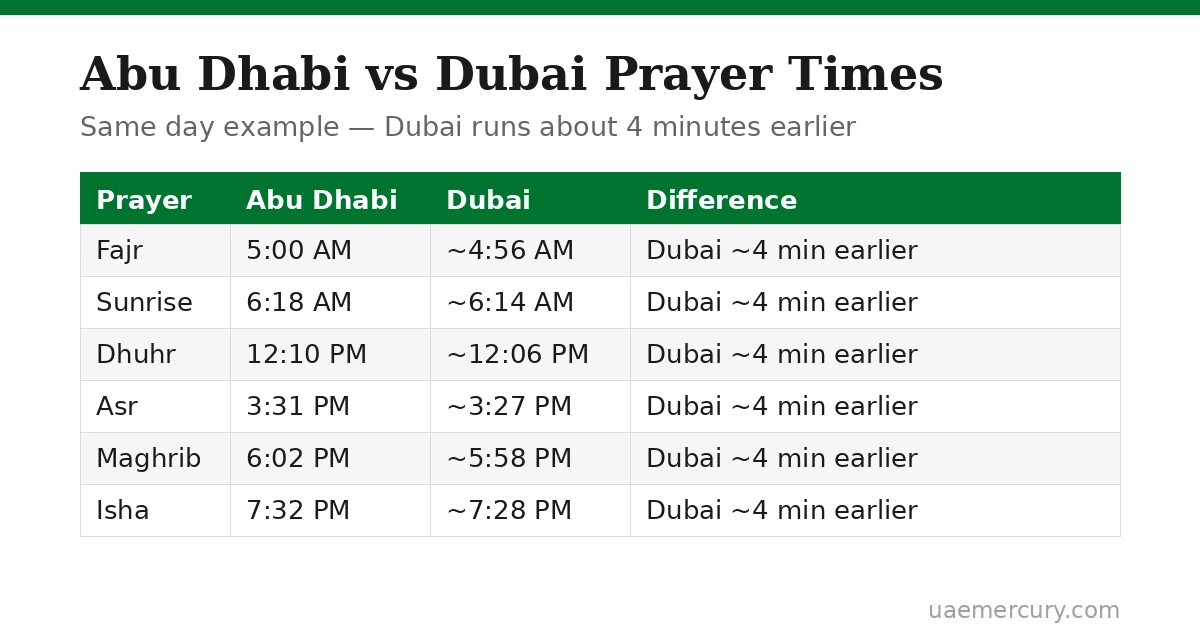
| Prayer | Abu Dhabi (example) | Dubai (example) | Difference |
|---|---|---|---|
| Fajr | 5:00 AM | ~4:56 AM | Dubai ~4 min earlier |
| Sunrise | 6:18 AM | ~6:14 AM | Dubai ~4 min earlier |
| Dhuhr | 12:10 PM | ~12:06 PM | Dubai ~4 min earlier |
| Asr | 3:31 PM | ~3:27 PM | Dubai ~4 min earlier |
| Maghrib | 6:02 PM | ~5:58 PM | Dubai ~4 min earlier |
| Isha | 7:32 PM | ~7:28 PM | Dubai ~4 min earlier |
Example times for Friday, October 9, 2026. Dubai times are approximate — derived from the longitude difference. The gap stays roughly constant all year.
Why Dubai Is Earlier: It’s the Sun, Not the Clock
Prayer times are solar: each prayer begins when the sun reaches a specific position over your location. Dubai sits at about 55.27° E longitude; Abu Dhabi at 54.38° E. The sun moves 15° per hour — so every degree of longitude east means the sun arrives about 4 minutes sooner.
Dubai is roughly 0.9° east of Abu Dhabi → about 3.5–4 minutes earlier, which in practice shows up as a 3–5 minute gap. The same logic extends across the emirates: Sharjah (further east still) runs about 5–8 minutes earlier than Abu Dhabi — see our Sharjah prayer times guide.
This is also why both cities use the same calculation method — the UAE Dubai method (18.2°/18.2°, +3 min offsets, official AWQAF timetable) — yet produce different times. Same math, different longitude. For the full explanation see how prayer times are calculated in the UAE.
Does the Difference Change Through the Year?
No — the 3–5 minute gap is essentially constant. What changes through the year are the absolute times (Fajr swings from ~4 AM in summer to ~5:30 AM in winter in both cities), but the offset between the cities barely moves, because it’s pure longitude.
What Stays the Same
- Jummah: since January 2026, the Friday sermon and prayer are at a unified 12:45 PM across the entire UAE — no difference between the cities
- Calculation method: identical (AWQAF official timetable in both)
- Qibla direction: nearly identical — about 259° from true north in Dubai, about 256–260° in Abu Dhabi (a couple of degrees of compass difference, negligible in practice). See our qibla direction guide
- Eid prayer rule: ~15–20 minutes after sunrise in both cities (the absolute time differs by those same 3–5 minutes)
Advice for Commuters
The Abu Dhabi–Dubai commute is one of the busiest in the country, and prayer timing trips people up:
- Don’t copy-paste timetables. Use each city’s own times — our Abu Dhabi prayer times page for the capital.
- Fajr and Maghrib matter most. A 4-minute error on Dhuhr is harmless; praying Fajr 4 minutes early (before dawn) or breaking fast 4 minutes early in Ramadan is not.
- Set your prayer app’s city, not just “UAE.” Most apps let you pick the exact city — do it. See best prayer time apps for the UAE.
- On the road at Maghrib: highway mosques and petrol-station prayer rooms along the E11 follow their local city’s times.
- In Ramadan: iftar in Dubai comes ~4 minutes before Abu Dhabi — relevant if you’re driving between the two at sunset. See our Ramadan 2026 Abu Dhabi timetable.
Abu Dhabi vs Dubai vs Sharjah at a Glance
| City | Longitude | vs Abu Dhabi |
|---|---|---|
| Sharjah | ~55.42° E | ~5–8 min earlier |
| Dubai | ~55.27° E | ~3–5 min earlier |
| Abu Dhabi | 54.38° E | — (reference) |
Approximate. Within each city, neighbourhoods differ by up to ~2 minutes.
Why One Timetable Can’t Cover Both Cities
Some newcomers ask: why doesn’t the UAE just publish one national timetable? Because prayer is worship, not administration — and Islamic law ties each prayer to the actual sun over your head. A single timetable would have half the country praying Fajr minutes before dawn or breaking fast minutes before sunset. The few minutes matter precisely because they’re religiously load-bearing: they mark the boundary between valid and invalid worship at dawn and dusk. So the UAE publishes one method (AWQAF’s) and lets each city’s longitude produce its own times.
The Other Emirates, Compared
The same longitude logic extends across the country:
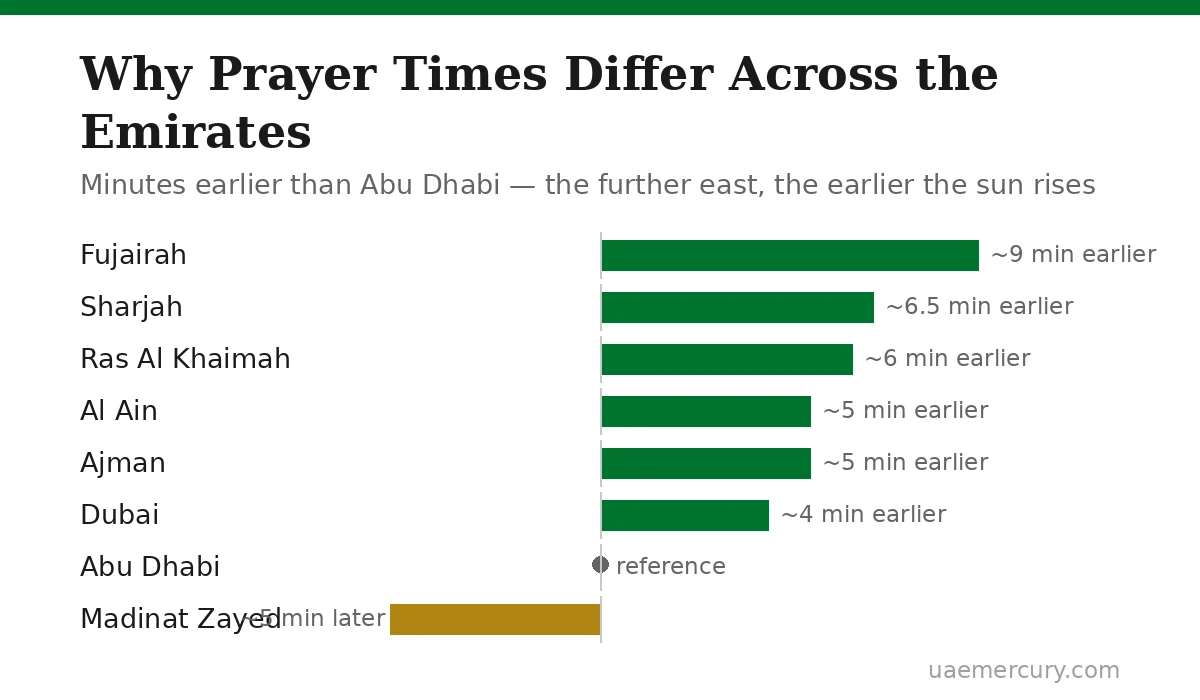
| Emirate/City | vs Abu Dhabi | Why |
|---|---|---|
| Sharjah | ~5–8 min earlier | Further east (55.42° E) |
| Dubai | ~3–5 min earlier | East of Abu Dhabi (55.27° E) |
| Ajman / Umm Al Quwain | ~4–6 min earlier | Similar longitude to Sharjah |
| Ras Al Khaimah | ~5–7 min earlier | Northeast coast |
| Fujairah | ~8–10 min earlier | East coast, furthest east |
| Al Ain | ~4–6 min earlier | Inland east (55.74° E) |
| Madinat Zayed (Al Dhafra) | ~5 min later | West of the capital (53.65° E) |
Approximate. See our area guides for Al Ain and Madinat Zayed.
Setting Your Prayer App for Two Cities
If you split time between Abu Dhabi and Dubai, don’t keep switching manual offsets — it’s error-prone. Instead:
- Use an app with GPS auto-location (Athan, My Prayer and most major apps have it) so times follow you
- Or save both cities as favourites and switch with one tap
- Keep the same calculation method (Dubai/UAE or MWL) in both — only the city changes
- See our best prayer time apps for the UAE for setup walkthroughs
A Commuter’s Prayer Diary: One Day, Two Cities
To make the difference concrete, here’s how Friday, October 9, 2026 plays out for someone living in Abu Dhabi and working in Dubai:
- 4:56 AM — Dubai’s Fajr athan sounds. You’re in Abu Dhabi, where Fajr isn’t until 5:00 AM. If your app is set to Dubai, you’d pray 4 minutes before dawn — too early.
- 12:06 PM — Dhuhr enters in Dubai while you’re at your desk there. Correct.
- 12:45 PM — Jummah. Same time in both cities — no confusion, by design.
- 3:27 PM — Asr in Dubai. You drive home.
- 5:58 PM — Maghrib in Dubai — but you’re now crossing into Abu Dhabi, where Maghrib is 6:02 PM. In Ramadan, you’d wait for the Abu Dhabi athan.
- 7:28 PM — Isha in Dubai; 7:32 PM in Abu Dhabi. Pray at home, on Abu Dhabi time.
The rule that never fails: pray on the times of wherever you physically are. Your body follows the sun overhead, not the city on your app’s home screen.
A Short History of Standardised Times
Before modern timetables, each mosque set prayer times by direct observation — the muezzin watched the horizon. Times naturally varied street to street. The 20th century brought computed timetables, and the UAE’s unification of the method under AWQAF (with the Dubai-method parameters and the +3 minute offset) gave the country something rare: every mosque, from a Fujairah fishing village to a Liwa desert outpost, on the same mathematical footing. The remaining differences between cities aren’t inconsistencies — they’re astronomy working exactly as intended. See how prayer times are calculated in the UAE for the full method.
The Bottom Line
Dubai is 3–5 minutes earlier than Abu Dhabi for every prayer, every day of the year — same method, same AWQAF authority, different longitude. It is a small gap with real consequences at dawn and dusk, so use each city’s own timetable: our Abu Dhabi prayer times hub for the capital, and a GPS-based app when you’re between the two. And on Fridays, relax — Jummah is 12:45 PM everywhere in the UAE.
Frequently Asked Questions
Are Abu Dhabi and Dubai prayer times the same?
No. Dubai is about 3–5 minutes earlier than Abu Dhabi for every prayer, because it lies further east and the sun reaches each prayer position sooner there.
Why is there a difference if both use the same method?
Both cities use the UAE’s official AWQAF timetable (Dubai method, 18.2°/18.2°). The difference is pure geography: prayer times are computed from the sun’s position over your exact longitude.
Which city has earlier Fajr — Abu Dhabi or Dubai?
Dubai. Its Fajr is about 3–5 minutes earlier than Abu Dhabi’s every day of the year.
Does the time difference change in summer and winter?
No. The absolute times swing with the seasons, but the 3–5 minute gap between the cities stays constant — it’s determined by longitude alone.
Is Jummah at the same time in Abu Dhabi and Dubai?
Yes. Since January 2026, Jummah is held at a unified 12:45 PM across the entire UAE.
Can I use Dubai prayer times in Abu Dhabi?
You shouldn’t — you’d be up to 5 minutes early, which matters for Fajr (praying before dawn) and for breaking fast in Ramadan. Use each city’s own timetable.
What about Sharjah vs Abu Dhabi?
Sharjah is further east than Dubai, so it runs about 5–8 minutes earlier than Abu Dhabi. See our Sharjah prayer times guide.
Is the qibla direction different in Abu Dhabi and Dubai?
Barely — about 259° from true north in Dubai vs about 256–260° in Abu Dhabi. The difference is negligible in practice.
Last updated: October 2026. City differences are approximate — always confirm daily times with your local mosque.
Pingback: Asr Prayer Time Abu Dhabi: Today & Guide (2026)
Pingback: Abu Dhabi Prayer Timetable: Monthly Schedule (2026)
Pingback: Athan Times Abu Dhabi: Call to Prayer Guide (2026)
Pingback: Dhuhr Prayer Time Abu Dhabi: Today & Guide (2026)
Pingback: Isha Prayer Time Abu Dhabi: Today & Guide (2026)
Pingback: Prayer Time Abu Dhabi: Today's Timetable (2026 Guide)