
Ever wondered how prayer times are calculated in the UAE? They are not estimates and they are not fixed by the clock — they are precise astronomical calculations based on the sun’s position over your exact location. This guide explains the method the UAE officially uses, how it differs from other methods worldwide, and why two websites can show slightly different times for the same day.
The short version: the UAE uses the “Dubai method” — Fajr and Isha when the sun is 18.2° below the horizon, plus a 3-minute safety offset on the sun-based prayers. Every mosque in the country follows the official AWQAF timetable built on this method.
Prayer Times Are Sun Times, Not Clock Times
Each of the five daily prayers is tied to a specific position of the sun. That is why prayer times shift by a minute or two every day and swing widely between summer and winter.
| Prayer | Astronomical definition |
|---|---|
| Fajr | True dawn — the first horizontal light on the eastern horizon, when the sun is a set number of degrees below the horizon |
| Sunrise (ShurÅ«q) | The sun’s upper edge appears on the horizon (astronomically −0.833°, accounting for refraction) |
| Dhuhr | The sun crosses the local meridian — solar noon, just after the sun passes its highest point |
| Asr | When an object’s shadow reaches a set length relative to the object (juristic setting, see below) |
| Maghrib | The sun’s disk fully disappears below the horizon (sunset) |
| Isha | Nightfall — twilight has disappeared, when the sun is a set number of degrees below the horizon |
The UAE “Dubai Method” (Official)
The official prayer timetable for the UAE is published by AWQAF — the General Authority of Islamic Affairs, Endowments and Zakat. It uses a method commonly called the Dubai method:
- Fajr: sun at 18.2° below the horizon
- Isha: sun at 18.2° below the horizon
- Sunrise, Dhuhr, Asr, Maghrib: calculated astronomically, then +3 minutes added as a precautionary offset
- Asr juristic setting: Standard (Shafi’i/Maliki/Hanbali) — shadow length equals object length
The +3 minute offset is a safety margin so that nobody prays before the time has truly entered. This is why the UAE’s official times run a touch later than a raw astronomical calculation.
How Other Methods Compare
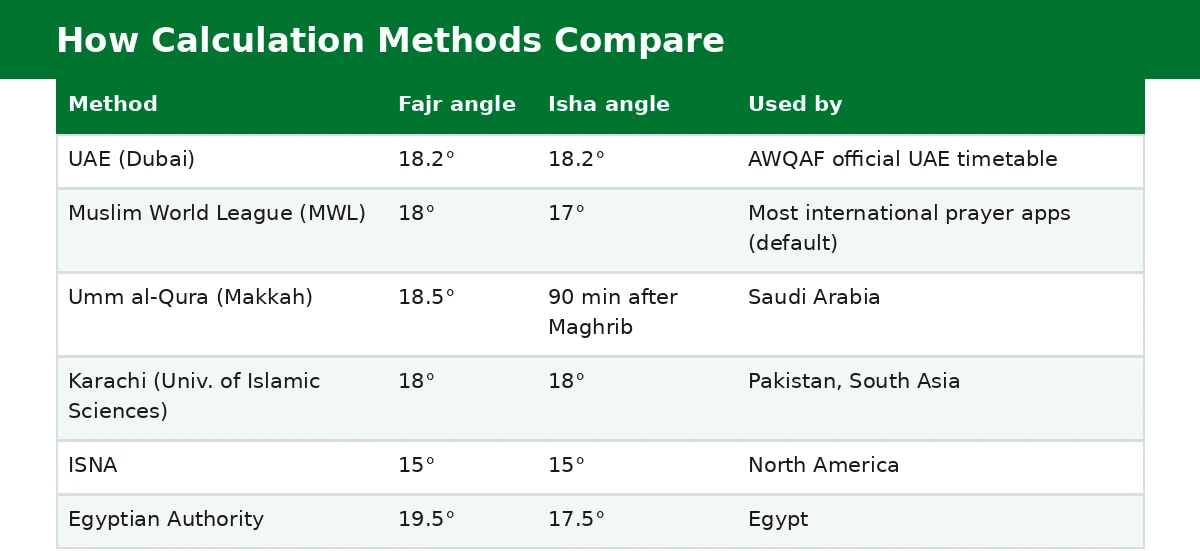
Apps and websites that are not using the UAE method use one of the global conventions below. All of them are legitimate scholarly positions — they just measure twilight slightly differently:
| Method | Fajr angle | Isha angle | Used by |
|---|---|---|---|
| UAE (Dubai) | 18.2° | 18.2° | AWQAF official UAE timetable |
| Muslim World League (MWL) | 18° | 17° | Most international prayer apps (default) |
| Umm al-Qura (Makkah) | 18.5° | 90 min after Maghrib | Saudi Arabia |
| Karachi (Univ. of Islamic Sciences) | 18° | 18° | Pakistan, South Asia |
| ISNA | 15° | 15° | North America |
| Egyptian Authority | 19.5° | 17.5° | Egypt |
In practice, the UAE method and the MWL method (the default on most apps) agree within 1–3 minutes. If your app offers a “Dubai” or “UAE” calculation option, choose it for the closest match to your mosque’s adhan.
Why Asr Has Two Different Times
You may notice some timetables list two Asr times. This is the one genuine juristic difference in the calculation:
- Standard (Shafi’i, Maliki, Hanbali): Asr begins when an object’s shadow equals the object’s length (plus the noon shadow). In Abu Dhabi on October 9, 2026, that is about 3:31 PM.
- Hanafi: Asr begins when the shadow is twice the object’s length — roughly 50–60 minutes later (about 4:25 PM on the same day).
The UAE’s official timetable uses the standard setting. If you follow the Hanafi school, add roughly an hour to the published Asr time — or set your app’s madhab to Hanafi.
Why Do Different Websites Show Different Times?
A 2–5 minute difference between sources is completely normal and comes from four things:
- Calculation method — 18.2° vs 18° vs 15° twilight angles move Fajr and Isha by several minutes
- The +3 minute UAE offset — only the official timetable and UAE-specific apps apply it
- Coordinates — a site using “Dubai” coordinates for an Abu Dhabi search will be 3–5 minutes off; even neighbourhoods within Abu Dhabi differ by up to 2 minutes
- Rounding — some sites round up to the next minute, others truncate
None of this means any of them are “wrong” — but for worship, the rule is simple: follow your local mosque’s adhan or the official AWQAF timetable. See our Abu Dhabi prayer timetable for the month-by-month picture.
The Math, Briefly
Under the hood, every method does the same spherical-trigonometry computation. Given your latitude (φ), the sun’s declination (δ) for the date, and the twilight angle you want, the hour angle H is:
cos(H) = [sin(angle) − sin(φ)·sin(δ)] / [cos(φ)·cos(δ)]
The time is then solar noon ± H/15 hours, converted to your timezone (UTC+4 for the UAE, with no daylight saving). Dhuhr is solar noon itself; Asr uses the shadow-length formula; Maghrib and sunrise use −0.833°. Our live Abu Dhabi prayer widget runs exactly this algorithm in your browser.
Abu Dhabi’s Coordinates
All UAE prayer calculations start from precise geography. Abu Dhabi city sits at 24.4539° N, 54.3773° E, in the UTC+4 timezone, with no daylight saving — so the timetable is pure astronomy, never shifted by a clock change. (Compare Sharjah’s times, about 5–8 minutes earlier because Sharjah lies further east.)
Example: Friday, October 9, 2026
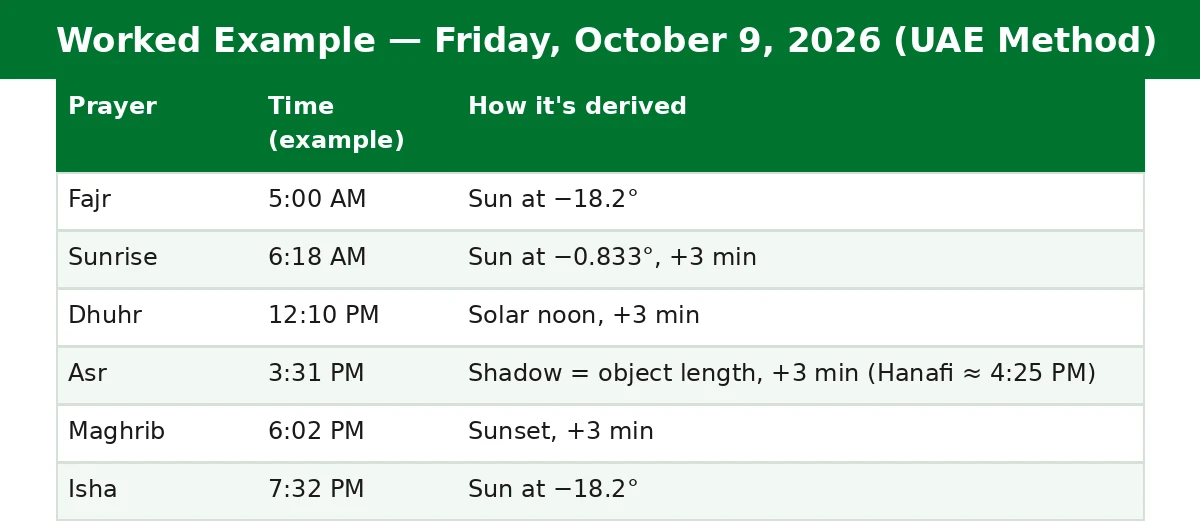
Here is what the UAE method produces for Abu Dhabi on October 9, 2026 — an example of the calculation in action:
| Prayer | Time (example) | How it’s derived |
|---|---|---|
| Fajr | 5:00 AM | Sun at −18.2° |
| Sunrise | 6:18 AM | Sun at −0.833°, +3 min |
| Dhuhr | 12:10 PM | Solar noon, +3 min |
| Asr | 3:31 PM | Shadow = object length, +3 min (Hanafi ≈ 4:25 PM) |
| Maghrib | 6:02 PM | Sunset, +3 min |
| Isha | 7:32 PM | Sun at −18.2° |
How to Get the Official Times
- Your mosque’s adhan — follows the AWQAF calendar; the gold standard
- Printed monthly timetables — available in every UAE mosque
- Prayer apps — set location to your city and method to “Dubai/UAE” (or MWL as the closest fallback). See our best prayer time apps for the UAE
- This site’s live widgets — computed daily with the UAE 18.2°/18.2° method; approximate, so confirm with your mosque
The +3 Minute Offset, Explained
The UAE’s +3 minute precautionary offset on sunrise, Dhuhr, Asr and Maghrib exists for a simple reason: astronomical calculations are exact, but human observation isn’t. Adding a few minutes guarantees nobody prays Dhuhr before the sun has truly crossed the meridian, or breaks fast before the sun has truly set. It is a deliberate safety margin built into the official timetable — not an error, and not something to “correct” by subtracting.
Note the offset applies only to the sun-position prayers. Fajr and Isha need no offset because their 18.2° twilight angles already contain a wide margin.
A Worked Mini-Example: Dhuhr in Abu Dhabi
Take October 9, 2026. Abu Dhabi’s longitude is 54.3773° E; the UAE timezone meridian is 60° E (UTC+4). Solar noon happens when the sun crosses your meridian — roughly (60 − 54.3773) / 15 ≈ 22.5 minutes after 12:00 UTC, i.e. around 12:07 PM local, plus the equation-of-time correction for the date (a few minutes either way), plus the 3-minute offset — landing at the published 12:10 PM. Every other prayer is the same idea: compute the sun’s position, convert to local time, add the offset where applicable.
What About High Latitudes?
The angle method breaks down near the poles — in midsummer above the Arctic Circle the sun never dips 18° below the horizon, so “Fajr at −18.2°” never occurs. Scholars have devised fallback rules (nearest-latitude, nearest-day, middle-of-night, one-seventh-of-night). The UAE never faces this problem: at 24° N the sun always plunges well below the horizon, so the standard calculation works cleanly every night of the year.
How AWQAF Publishes the Timetable
AWQAF computes the year’s timetable in advance and distributes it to every mosque: printed monthly calendars on notice boards, the announced adhan schedule, and digital feeds used by UAE media. Because every mosque follows the same calendar, the athan rolls across a city within seconds — that synchronised wave of sound is the timetable made audible. When AWQAF adjusts anything (it rarely does), mosques update together.
Frequently Asked Questions
What calculation method does the UAE use for prayer times?
The UAE uses the “Dubai method”: Fajr and Isha at 18.2° below the horizon, with a +3 minute precautionary offset on sunrise, Dhuhr, Asr and Maghrib. The official timetable is published by AWQAF.
Who is AWQAF?
AWQAF is the UAE’s General Authority of Islamic Affairs, Endowments and Zakat. It publishes the official prayer timetable that all mosques in the UAE follow.
Why do prayer apps show different times than my mosque?
Most apps default to the Muslim World League method (18°/17°) without the UAE’s +3 minute offset, causing a 2–5 minute difference. Set your app’s method to “Dubai” or “UAE” if available, or follow your mosque’s adhan.
What is the difference between Shafi’i and Hanafi Asr?
Standard (Shafi’i) Asr begins when a shadow equals the object’s length; Hanafi Asr begins when the shadow is twice the length — about 50–60 minutes later. The UAE official timetable uses the standard setting.
Do prayer times change with daylight saving in the UAE?
No — the UAE does not observe daylight saving. Prayer times follow pure solar astronomy all year in the UTC+4 timezone.
What are the twilight angles for Fajr and Isha in the UAE?
Both are 18.2° below the horizon under the UAE Dubai method. For comparison: Muslim World League uses 18°/17°, Umm al-Qura uses 18.5° for Fajr, and Karachi uses 18°/18°.
Why are prayer times different in Abu Dhabi and Dubai?
Because prayer times are solar: Dubai lies east of Abu Dhabi, so the sun reaches each prayer position 3–5 minutes earlier there. See our Abu Dhabi vs Dubai comparison.
Is there one “correct” calculation method?
All major methods are legitimate scholarly positions differing on how to measure twilight. In the UAE, the correct practical answer is the official AWQAF timetable — that is what every mosque follows.
Last updated: October 2026. Calculation settings described here reflect the UAE’s official method; always confirm daily times with your local mosque.
Pingback: Prayer Time Corniche Abu Dhabi: Today's Times (2026)
Pingback: Prayer Time Khalifa City: Today's Times (2026)
Pingback: Prayer Time Madinat Zayed: Today's Times (2026)
Pingback: Prayer Time Mussafah: Today's Timetable (2026)
Pingback: Prayer Time Al Ain: Today's Timetable (2026)
Pingback: Prayer Time Yas Island: Today's Timetable (2026)
Pingback: Ramadan 2026 Abu Dhabi: Suhoor & Iftar Timetable
Pingback: Sheikh Zayed Grand Mosque: Prayer & Visit Guide