











Yes, you can check your credit score in the UAE in about five minutes, and there is only one official place to get it: Etihad Credit Bureau, the federal credit bureau (formerly called Al Etihad Credit Bureau, or AECB).
The score costs AED 10.50 and the full credit report costs AED 84, both including VAT. You buy them on the bureau’s app or website with UAE Pass, and no bank, agent or third-party site can give you the genuine number.
This guide walks through the exact steps, the new Credit Score 3i ranges that replaced the old 300 to 900 scale in October 2026, what counts as a good score, and how to improve a weak one.
The only official source: Etihad Credit Bureau
Etihad Credit Bureau is the UAE’s only credit bureau. It is a federal entity, and it collects your credit data from banks, finance companies, telecom operators and utility providers across the country.
Every time you apply for a loan, a credit card, a car finance deal or even a postpaid plan, the provider checks your bureau file. That is why this one score follows you around the UAE’s financial system.
Third-party apps and websites sometimes advertise a “free UAE credit score”. None of them are the bureau, and none of them can show your real Etihad Credit Bureau score. If it did not come from etihadbureau.ae or the official app, it is not your official score.
How to check your credit score on the app, step by step
The Etihad Credit Bureau app is the fastest route. The whole process takes a few minutes if your UAE Pass is already set up.
1. Download the Etihad Credit Bureau app from the Apple App Store or Google Play.
2. Sign in with UAE Pass. The bureau uses UAE Pass to verify your identity against your Emirates ID.
3. Choose your product: Credit Score on its own for AED 10.50, or the full Credit Report for AED 84, which includes the score.
4. Pay by card. Both prices include VAT, and the app shows the exact fee before you pay.
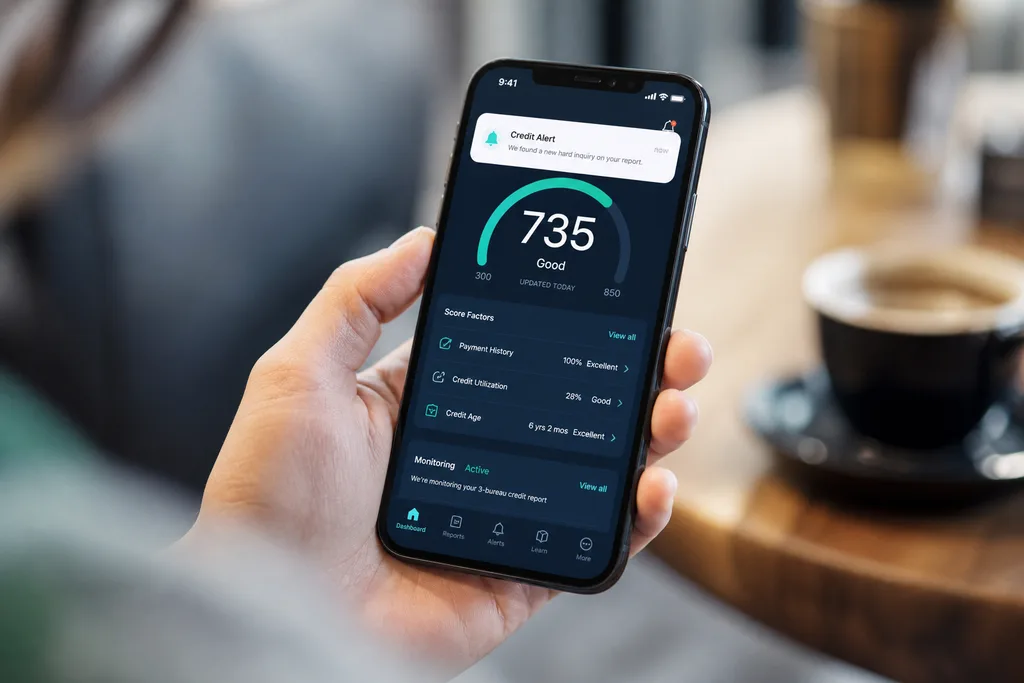
5. View your score on screen or download the report as a PDF. The app also shows the main positive and negative factors behind your score, a feature added with Credit Score 3i.
If you only want the number, the AED 10.50 score is enough. If you are about to apply for a mortgage or a large loan, buy the AED 84 report instead, because it shows every account and late payment behind the number.
How to check on the website or in person
Prefer a computer? The bureau’s website, etihadbureau.ae, sells the same two products. Log in with UAE Pass or register with your Emirates ID and mobile number, pay online, and download your score or report as a PDF within minutes.
Your score is also available through the TAMM and DubaiNow government apps, which connect to the same bureau services.
And if you would rather deal with a person, the bureau has a walk-in customer centre at its Abu Dhabi office, where staff can help you buy and understand your report.
Whichever channel you use, the product and the price are the same, because every channel leads back to the same bureau file. Before a big application, it also helps to know how your salary stacks up against bank expectations, which our guide to whether 5,000 AED salary is enough in Dubai breaks down in detail.
What your credit report actually shows

The credit report is the full file behind the score. It lists your personal details, every loan and credit card registered to your Emirates ID, and your last salary as reported by your bank.
It also shows 36 months of payment history on each facility, any bounced cheques, and court-ordered financial obligations. This is the document a bank’s credit team is effectively reading when they assess you.
Read it line by line at least once a year. Errors do happen, and a wrong late payment or a closed card still showing a balance can quietly drag your score down until you spot it and raise a dispute with the bureau.
UAE credit score ranges: the new Credit Score 3i
On 29 October 2026 the bureau replaced its old scoring model with Credit Score 3i. The biggest change: the famous 300 to 900 range is gone for most people, and there are now two scales depending on how much credit history you have.
| Score type | Range | Who gets it |
|---|---|---|
| Established credit score | 300 to 850 | Residents with an existing credit history in the UAE |
| New-to-credit score | 300 to 650 | People new to credit, or new to the UAE, with a limited history |
| Old model (before Oct 2026) | 300 to 900 | The scale older guides and bank leaflets still quote |
The new model also looks at 36 months of your behaviour instead of 24, and it scores newcomers who previously had no number at all. If an older article tells you the UAE score runs to 900, it is describing the retired model.
For the main 300 to 850 scale, the bureau’s published guide bands look like this:
| Band | Score | What it signals to lenders |
|---|---|---|
| Excellent | 790 and above | Lowest risk; best rates and highest approval odds |
| Very good | 756 to 789 | Strong file; most products within reach |
| Good | 674 to 755 | Healthy file; standard approvals expected |
| Fair | 524 to 673 | Some blemishes; approvals possible but not guaranteed |
| Weak | 300 to 523 | High risk; most lenders will decline or ask for security |
Treat these bands as a guide, not a promise. The bureau itself stresses that a score never guarantees approval, because every bank applies its own internal cut-off on top of the number.
What is a good credit score in the UAE?
On the current scale, aim for 674 or above to sit in the “good” band, and 756 or above to be comfortably strong. That answers the questions people ask most:
Is 700 a good credit score in the UAE? Yes. A score of 700 falls inside the good band (674 to 755), so most banks will view your file favourably.
Is 667 a good credit score? Not quite. At 667 you are in the fair band, just seven points below good. A few months of clean payments can usually push you over the line.
Is 620 a poor credit score? It is fair rather than poor, but it is below average. Expect some lenders to hesitate, charge more, or approve a smaller amount until the score climbs.
One caution for anyone comparing old articles: on the retired 300 to 900 scale, bank guides such as ADCB’s treated roughly 651 to 710 as good. The same number means slightly different things on each scale, so always check which scale a guide is using.
What affects your credit score

The bureau’s own list of score factors is short and practical. Payment behaviour comes first: paying every card, loan and bill on time, every month, is the single biggest driver.
Next is credit utilisation, meaning how much of your card limits you actually use. Running cards close to their limits signals stress, even if you pay on time. Recent credit applications matter too, because several applications in a short window look like desperation to the model.
The remaining factors are your active credit usage, your longer payment history, and your cheque behaviour. Bounced cheques are recorded and they hurt, which surprises many residents who treat cheques casually.
One modern note: buy-now-pay-later plans from providers like Tabby and Tamara now appear on your credit report, but the bureau says they do not currently affect the Credit Score 3i calculation itself.
How to improve your credit score
Improvement is boring, and that is good news: the model rewards steady behaviour, not tricks. Pay every obligation on or before its due date, and set up auto-pay so a busy month cannot create a late mark.
Keep card balances low relative to their limits, ideally well under half. Stop applying for new cards and loans while you rebuild, because each application leaves an enquiry on your file.
If you have defaults or bounced cheques, settle them. Under Credit Score 3i, consistent clean behaviour after settling a default can start lifting you out of the lowest band within about six months, although the bureau is clear this is not guaranteed and new negative data will slow you down.
Finally, check your full report for errors and dispute anything wrong. And if your score problem is really an income problem, our cost of living guide for a single person in Dubai can help you find the monthly slack to pay balances down faster.