
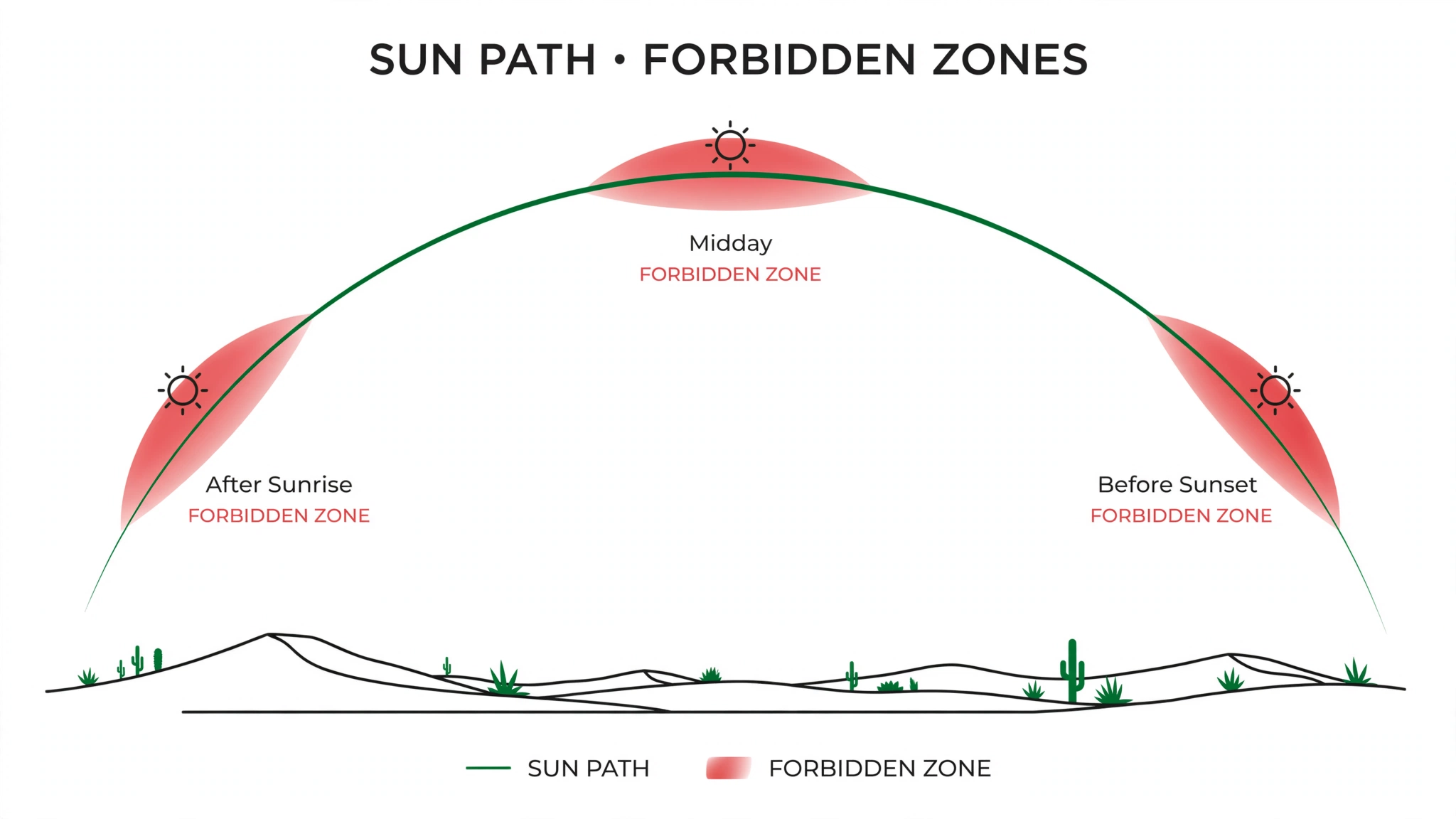
Are there times when prayer is forbidden in Islam? Yes — three short periods each day when voluntary prayers should not be performed. They are tied to the sun’s position: just after sunrise, when the sun is at its zenith (zawal), and just before sunset. This guide explains all three, with approximate timings for the UAE, and what you can and cannot do during them.
These are sometimes called the makruh (disliked) times for prayer. Knowing them matters most around Fajr (don’t pray Sunnah right after sunrise), midday (wait for Dhuhr), and Asr (don’t delay it into the pre-sunset minutes).
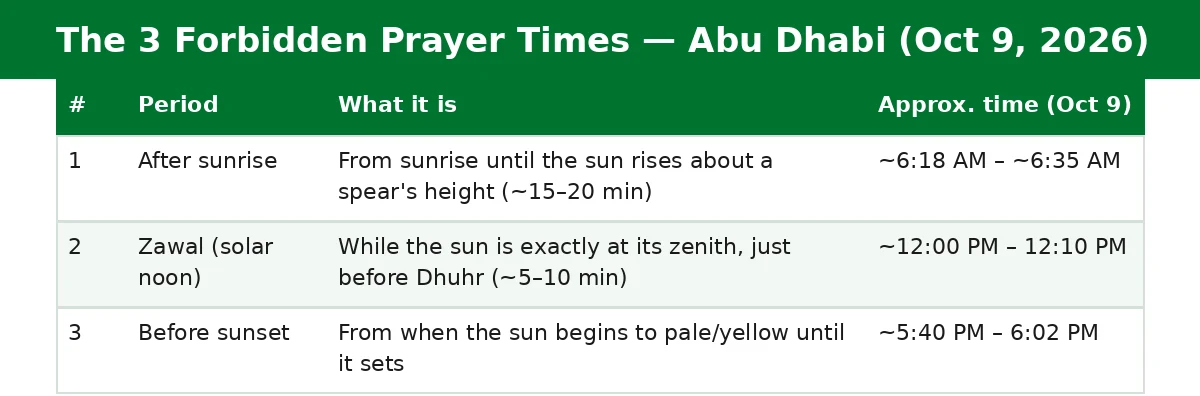
The 3 Forbidden Prayer Times
| # | Period | What it is | Approx. on Oct 9, 2026 (Abu Dhabi) |
|---|---|---|---|
| 1 | After sunrise | From sunrise until the sun rises about a spear’s height (~15–20 min) | ~6:18 AM – ~6:35 AM |
| 2 | Zawal (solar noon) | While the sun is exactly at its zenith, just before Dhuhr (~5–10 min) | ~12:00 PM – 12:10 PM |
| 3 | Before sunset | From when the sun begins to pale/yellow until it sets | ~5:40 PM – 6:02 PM |
Approximate windows based on the October 9, 2026 example times (Sunrise 6:18 AM, Dhuhr 12:10 PM, Maghrib 6:02 PM). The exact minutes shift daily with the sun.
1. Just After Sunrise (~15–20 Minutes)
From the moment the sun begins to rise until it is fully up and clear of the horizon — about 15–20 minutes. This is why Ishraq is prayed after this window, not at sunrise itself, and why a missed Fajr made up as qada should wait until the sun has risen fully.
2. Zawal — The Sun at Its Zenith
The brief period when the sun is at its absolute highest point, directly overhead — roughly the 5–10 minutes before the published Dhuhr time. Simply wait for the Dhuhr adhan, then pray.
3. Just Before Sunset
From when the sun starts to lose its brightness and yellow/pale until it has fully set (Maghrib). This is why Asr should not be delayed into the last minutes of the day — pray it well before the sun begins to set.
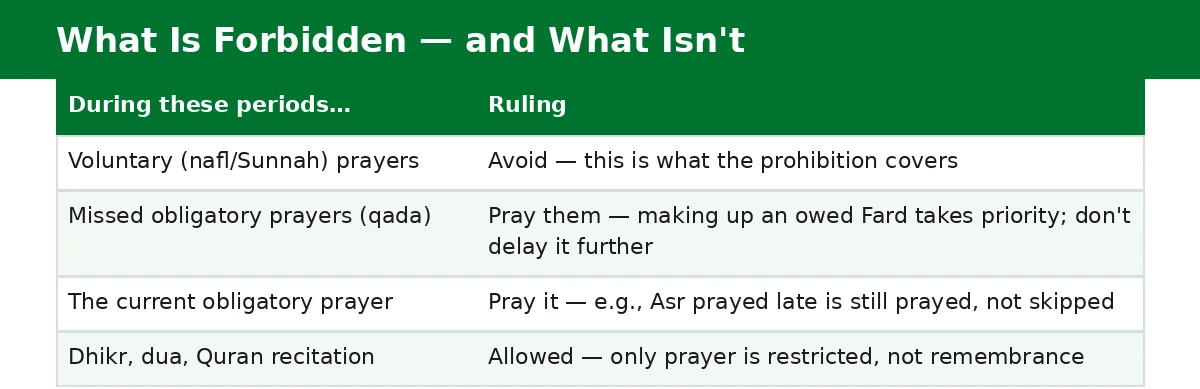
What Is Forbidden — and What Isn’t
| During these periods… | Ruling |
|---|---|
| Voluntary (nafl/Sunnah) prayers | Avoid — this is what the prohibition covers |
| Missed obligatory prayers (qada) | Pray them — making up an owed Fard takes priority; don’t delay it further |
| The current obligatory prayer | Pray it — e.g., Asr prayed late is still prayed, not skipped |
| Dhikr, dua, Quran recitation | Allowed — only prayer is restricted, not remembrance |
The wisdom traditionally given: these are the moments associated with sun-worship, so the prayer is kept clear of any resemblance to it.
Practical Examples
- Woke up after sunrise having missed Fajr? Wait ~15–20 minutes until the sun is fully up, then pray Fajr as qada
- Want to pray Duha at 11:55 AM? Check the Dhuhr time first — if zawal is near, wait for the adhan
- It’s 5:50 PM and you haven’t prayed Asr? Pray it immediately — don’t wait, and don’t push into the pre-sunset minutes deliberately
- Arrived at the mosque at sunrise? Sit in dhikr until the forbidden window passes, then pray Ishraq
For the complete daily schedule, see our Abu Dhabi prayer time guide and the monthly prayer timetable.
The Hadith Behind the Three Windows
The three forbidden periods come from a single, explicit hadith. Uqbah ibn Amir (may Allah be pleased with him) said: “There are three times at which the Messenger of Allah forbade us to pray or to bury our dead: when the sun begins to rise until it is fully up; when the sun is at its height at midday until it passes the meridian; and when the sun draws near to setting until it sets” (Muslim).
Note that the prohibition covers burying the dead alongside prayer — these are the only times in the day when even the funeral prayer is held off. The wisdom given in another narration (Amr ibn Abasah) is that the sun rises and sets “between the horns of Satan,” when sun-worshippers prostrate to it — so the Muslim prayer is kept visibly distinct from any resemblance to sun-veneration at exactly those moments.
Two More Discouraged Periods: After Fajr and After Asr
Beyond the three brief windows, there are two longer stretches when voluntary prayer is discouraged:
- After Fajr until sunrise — once you’ve prayed Fajr, no voluntary prayers until the sun is up (this is why Ishraq waits ~15–20 minutes past sunrise)
- After Asr until sunset — once you’ve prayed Asr, no voluntary prayers until Maghrib
The Prophet (peace be upon him) said: “There is no prayer after Asr until the sun sets, and no prayer after Fajr until the sun rises” (Bukhari, Muslim). These two periods are longer and the ruling is lighter than the three brief windows — and importantly, the majority of scholars allow makeup (qada) prayers during them: “Whoever forgets a prayer or sleeps through it, let him pray it when he remembers” (Bukhari, Muslim).
A Note on Madhab Differences
On whether a missed obligatory prayer may be made up inside the three brief windows, scholars differ — and the difference matters in practice:
| School | Qada during the 3 brief windows |
|---|---|
| Majority (Shafi’i, Maliki, Hanbali) | Allowed — an owed Fard is prayed immediately, since delaying it further is worse |
| Hanafi | Not allowed — no Fard, qada, or janazah prayer in the three brief windows; wait the few minutes until they pass |
Whichever position you follow, follow it consistently — and when in doubt in the UAE, ask your local imam. The windows themselves are only minutes long, so the practical cost of waiting is small either way.
Frequently Asked Questions
What are the three forbidden prayer times in Islam?
Just after sunrise (~15–20 min), when the sun is at its zenith (zawal, just before Dhuhr), and just before sunset until Maghrib.
Can I pray during the forbidden times?
Voluntary prayers should be avoided. But missed obligatory prayers (qada) and the current Fard should still be prayed — they take priority.
How long after sunrise can I pray?
Wait about 15–20 minutes until the sun has risen clear of the horizon — this is also when Ishraq begins.
What is zawal?
Zawal is the brief period when the sun is exactly at its zenith — roughly the 5–10 minutes before the published Dhuhr time. Wait for the adhan, then pray.
I woke up after sunrise and missed Fajr — what do I do?
Wait ~15–20 minutes until the sun is fully up, then pray Fajr as qada (make-up). Don’t skip it.
Can I read Quran or make dua during these times?
Yes — only prayer is restricted. Dhikr, dua, and Quran recitation are all allowed.
Why are these times forbidden for prayer?
The wisdom traditionally given is that these moments were associated with sun-worship, so the prayer is kept clear of any resemblance to it.
Do the forbidden times change through the year?
Yes — they track sunrise, solar noon, and sunset, which all shift seasonally. Check the live widget or monthly timetable for current times.
Which hadith describes the three forbidden prayer times?
Uqbah ibn Amir narrated: the Messenger of Allah forbade praying or burying the dead at three times — as the sun rises until fully up, at its midday height until it passes the meridian, and as it nears setting until it sets (Muslim).
Are there other times when voluntary prayer is discouraged?
Yes — after Fajr until sunrise, and after Asr until sunset: “There is no prayer after Asr until the sun sets, and no prayer after Fajr until the sun rises” (Bukhari, Muslim). These are longer, lighter restrictions than the three brief windows.
Can I make up a missed prayer during the three brief windows?
The majority of scholars say yes — an owed Fard is prayed immediately. The Hanafi school says no, and its followers should wait the few minutes until the window passes. Follow your school consistently.
Does the prohibition include the funeral (janazah) prayer?
Yes — the hadith mentions burying the dead alongside prayer, and scholars include the janazah prayer in the restriction. Funerals are simply scheduled around these brief windows.
Last updated: October 2026. Prayer times shift daily — always confirm with your local mosque.
Pingback: Ishraq Prayer Time Abu Dhabi: Sunrise Prayer (2026)