










Yes, Dubai tap water is safe to drink at the point where DEWA supplies it. The water moving through the city’s network meets World Health Organization standards, and DEWA says so on the record.
The honest answer has a second half, though. DEWA’s responsibility ends at your building’s meter. Between the meter and your tap, the water sits in your building’s storage tanks and pipes, and that last stretch is where quality is won or lost.
So the real question is not “is Dubai water safe?” but “is my building looked after?” This guide explains what DEWA guarantees, what your landlord is responsible for, and the simple checks that tell you whether to drink from your tap, filter, or stick to bottled.
What DEWA says about Dubai’s tap water

Almost all of Dubai’s tap water starts as seawater. DEWA desalinates it at huge coastal plants, including the Jebel Ali complex, treats it, and pumps it through the city network. Around 99% of the supply is desalinated seawater, with a small share from groundwater.
DEWA’s official position is unambiguous: “Our water quality across generation, transmission, and distribution networks meets the highest health and safety standards set by the World Health Organisation (WHO).”
The Emirates Authority for Standardisation and Metrology has likewise certified the municipal supply as safe for human consumption. In other words, the water itself, as supplied, is not the problem, and thousands of water quality tests back that up.
If you are setting up a home here, water quality is one less thing to budget for. Our guide to the upfront costs of renting in Dubai, including the DEWA deposit, covers the money side of getting connected.
The real caveat: your building’s storage tank
Here is the part most guides skip. DEWA guarantees the water up to your building’s meter. After the meter, as DEWA itself puts it, it is the responsibility of the customer or owner and the maintenance companies to maintain the internal networks and water tanks.
Most Dubai buildings store water in large tanks, often on the roof, before it reaches your flat. In Dubai’s heat, a neglected tank can collect sediment and support bacterial growth, and old internal pipes can add rust and off-flavours of their own.
Dubai Municipality’s rules are strict on paper: water tanks must be emptied, cleaned and disinfected at least twice a year by an approved company, with samples tested by an accredited laboratory. Well-run buildings follow this. Older, poorly managed ones may not, and you cannot tell from your kitchen.
That is why two neighbours on the same street can give opposite answers about tap water. They are drinking from the same DEWA network, but through very different tanks.
How to check the water in your own building

Start with one question to your building management or landlord: when were the water tanks last cleaned, and can I see the certificate? Approved cleaning companies issue documentation, and a good management company will share it without a fight.
Then do the simple home checks. Run the cold tap in the morning and look at the water in a clear glass: it should be clear, with no particles, no yellow or brown tint and no stale smell.
Use the cold tap for drinking, not the hot one, because hot water sits in heaters and picks up more from the system. If you have been away for weeks, let the tap run for a minute or two to flush standing water before you fill a glass.
Villa owners, the tank is yours. Book a Dubai Municipality approved cleaning company every six months, keep the test reports, and your tap water will be as good as the network supplying it.
Should you use a filter?
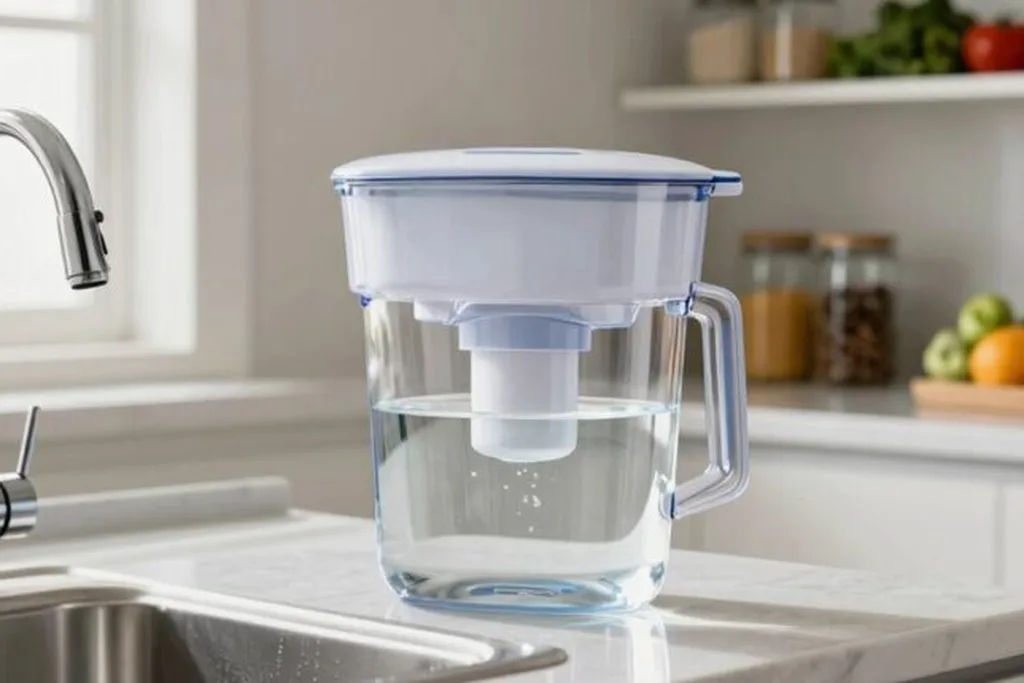
A filter is not strictly necessary for safety in a well-maintained building, but it is the most popular middle path in Dubai, and for a sensible reason: taste. Desalinated water is chlorinated for safety, and a simple carbon filter removes that taste completely.
A countertop jug filter is the cheapest option and suits most flats. Under-sink and whole-home systems cost more and make sense for villas or large families who drink a lot of water at home.
Whichever you choose, change the cartridge on schedule. An exhausted filter is worse than no filter, because it can harbour the very bacteria you were trying to avoid. Many residents combine approaches: filtered tap water for drinking, straight tap water for cooking, tea and coffee, where boiling and flavour make any difference disappear.
Tap vs bottled water: the cost difference
Money is where tap water wins outright. Tap water arrives on your DEWA bill and costs a tiny fraction of what bottled water costs over a month, especially for a family drinking several litres a day.
Bottled water adds up quietly: weekly five-gallon refills or cases of small bottles, delivery slots to wait in for, storage space in a small kitchen, and a steady stream of plastic. For a household, the annual difference runs into hundreds of dirhams.
There is also the practical side. If your building’s tank is properly maintained, bottled water buys you nothing in safety, only habit. If your building’s records are a mystery, a filter gives you the same peace of mind for far less money. Either way, our cost of living guide for a single person in Dubai shows where water and utilities sit in a realistic monthly budget.
New to Dubai, or staying in a hotel?
Hotels run on the same DEWA network and are held to the same Dubai Municipality tank rules, with inspections on top. In a reputable hotel, the tap water is fine for brushing teeth and is generally safe to drink.
Many hotels still provide complimentary bottled water, and most guests use it out of convenience. That is habit and hospitality, not a health warning.
New residents should make the tank question part of the flat-hunting checklist, alongside the rent and the chiller situation. Ask it before you sign, and you will never have to wonder about your tap again. Our guide to the best areas to live in Dubai for singles and young professionals is a good companion read.