
Looking for the Ishraq prayer time in Abu Dhabi? Ishraq is the voluntary morning prayer, prayed about 15–20 minutes after sunrise — once the sun has risen clear of the horizon. It is a short, beloved Sunnah: just 2 rakats to start your day with worship.
Watch: Chasht Ishraq Awabeen ki Namaz ka Bayan | Dr Farhat Hashmi
A scholarly explainer on Ishraq vs Chasht (Duha) vs Awwabin: timings, differences and virtues.
As an example, on Friday, October 9, 2026, sunrise in Abu Dhabi is at 6:18 AM, so Ishraq begins around 6:35 AM and runs until mid-morning. This guide covers the exact window, how to pray it, its virtues, and how it differs from Duha (Chasht) prayer.
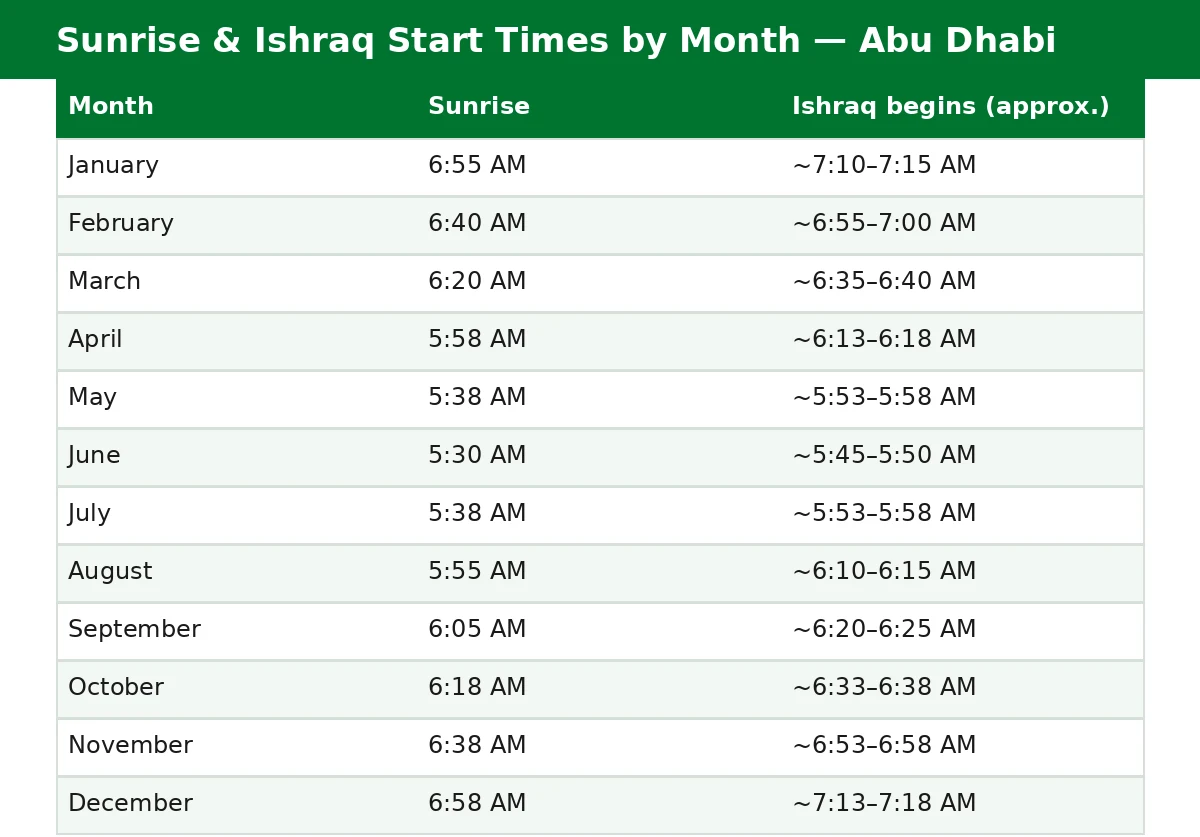
When Is Ishraq in Abu Dhabi?
Ishraq begins when the sun has risen to about a spear’s height above the horizon — practically, 15–20 minutes after sunrise. The window runs until mid-morning (before the sun approaches its zenith).
| Month | Sunrise | Ishraq begins (approx.) |
|---|---|---|
| January | 6:55 AM | ~7:10–7:15 AM |
| February | 6:40 AM | ~6:55–7:00 AM |
| March | 6:20 AM | ~6:35–6:40 AM |
| April | 5:58 AM | ~6:13–6:18 AM |
| May | 5:38 AM | ~5:53–5:58 AM |
| June | 5:30 AM | ~5:45–5:50 AM |
| July | 5:38 AM | ~5:53–5:58 AM |
| August | 5:55 AM | ~6:10–6:15 AM |
| September | 6:05 AM | ~6:20–6:25 AM |
| October | 6:18 AM | ~6:33–6:38 AM |
| November | 6:38 AM | ~6:53–6:58 AM |
| December | 6:58 AM | ~7:13–7:18 AM |
Approximate — sunrise + 15–20 minutes. Note the ~15–20 minutes immediately after sunrise are a forbidden prayer time; wait until the sun has clearly risen.
How Many Rakats Is Ishraq?
2 rakats is the standard Ishraq prayer. You may pray more in pairs if you wish — it falls under the broader Duha prayer, whose maximum is commonly given as 8 rakats.
How to Pray Ishraq (Step by Step)
- Pray Fajr (in congregation at the mosque if possible)
- Remain seated remembering Allah — Quran recitation, dhikr, dua — until the sun has risen
- Wait 15–20 minutes after sunrise until the sun is clearly up
- Pray 2 rakats facing the Qibla, intending Ishraq
The fullest reward is described for the one who prays Fajr in congregation, sits remembering Allah until sunrise, then prays two rakats — the reward of a complete Hajj and Umrah. A detailed explainer on Ishraq, Chasht, and Awwabin: Chasht, Ishraq & Awwabin Prayers Explained (YouTube).
Ishraq vs Duha (Chasht): What’s the Difference?
| Ishraq | Duha (Chasht) | |
|---|---|---|
| Time | Right after sunrise (+15–20 min) | Mid-morning until before Dhuhr |
| Rakats | 2 | 2–8 |
| Relationship | Many scholars consider them the same prayer (Salat al-Duha) — Ishraq is simply its earliest, most virtuous time; others treat them as distinct | |
For the complete daily schedule, see our Abu Dhabi prayer time guide and the monthly prayer timetable.
The Hadith: A Complete Hajj and Umrah
Ishraq carries one of the most striking reward-descriptions of any voluntary prayer. Anas ibn Malik (may Allah be pleased with him) narrated that the Prophet (peace be upon him) said: “Whoever prays Fajr in congregation, then sits remembering Allah until the sun has risen, then prays two rakats — for him is a reward like that of a Hajj and Umrah.” He repeated: “Complete, complete, complete” (Tirmidhi, graded hasan).
Note the three conditions built into the hadith:
- Fajr in congregation — the reward-description begins at the mosque
- Remaining seated in remembrance (dhikr, Quran, dua) until sunrise
- Two rakats after the forbidden post-sunrise window has passed
An important nuance: the full described reward is tied to staying in one’s place of prayer. Praying the two rakats at home or at work still earns the reward of Duha prayer — and scholars note that a woman praying at home receives the same reward when she sits in her prayer place in remembrance until sunrise and then prays the two rakats.
Ishraq, Duha, Awwabin: Untangling the Names
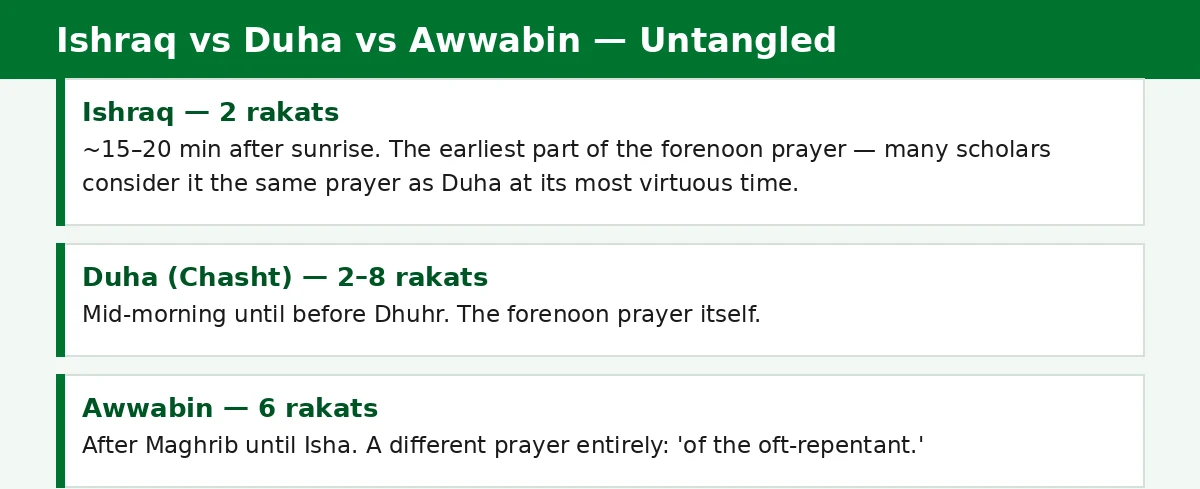
Three names cause constant confusion. Here’s how they fit:
| Prayer | When | Rakats | Notes |
|---|---|---|---|
| Ishraq | ~15–20 min after sunrise | 2 | The earliest part of the forenoon prayer |
| Duha (Chasht) | Mid-morning until before Dhuhr | 2–8 | The forenoon prayer itself |
| Awwabin | After Maghrib until Isha | 6 | A different prayer: “of the oft-repentant” |
Many scholars — including al-Atheem Abadi and al-Ramli of the Shafi’i school — consider Ishraq simply the beginning of Duha: one prayer, with Ishraq as its earliest and most virtuous time. Awwabin is separate: the voluntary prayer between Maghrib and Isha (see our Maghrib guide). So the morning prayer has two common names for one prayer; the evening one is something else entirely.
The Four-Rakat Promise for Your Day
There is a second morning-prayer narration worth knowing. Uqbah ibn Amir narrated that Allah says: “O son of Adam, suffice Me with four rakats at the beginning of the day, and I will suffice you till the end of it” (Musnad Ahmad; authenticated by al-Mundhiri).
The practical takeaway: if you have a few extra minutes after your two Ishraq rakats, add two more. Your morning prayer becomes the day’s down payment — four rakats at dawn in exchange for sufficiency till dusk.
Common Mistakes in Ishraq
- Praying at sunrise itself — inside the forbidden window. Wait the full 15–20 minutes until the sun is clearly up.
- Assuming it must be in the mosque. The mosque stay earns the full hadith reward, but the prayer itself is valid anywhere — at home, at the office, wherever you are when the time comes.
- Rushing the two rakats. This is a prayer of presence and gratitude at daybreak, not a checkbox to tick before work.
- Counting it twice. If you prayed Ishraq at sunrise, that is your Duha for the early morning — don’t treat them as two separate obligations.
Frequently Asked Questions
What time is Ishraq prayer in Abu Dhabi?
About 15–20 minutes after sunrise — around 6:35 AM on October 9, 2026 (sunrise 6:18 AM). Check the live widget above for today’s sunrise time.
How many rakats is Ishraq?
Two rakats is the standard Ishraq prayer; you may pray more in pairs.
Can I pray Ishraq immediately at sunrise?
No — the ~15–20 minutes right after sunrise are a forbidden prayer time. Wait until the sun has risen clearly.
What is the difference between Ishraq and Duha?
Many scholars consider them the same prayer (Salat al-Duha) — Ishraq is its earliest time, right after sunrise; Duha extends through mid-morning. Others treat them as distinct.
Do I need to stay in the mosque after Fajr for Ishraq?
Staying after Fajr in remembrance until sunrise carries the greatest described reward, but Ishraq itself can be prayed at home too.
When does Ishraq time end?
Mid-morning, before the sun nears its zenith — after that comes the brief forbidden period before Dhuhr.
Is Ishraq obligatory?
No — Ishraq is a voluntary (nafl) prayer, but a beloved and highly rewarded Sunnah.
Can women pray Ishraq at home?
Yes — pray Fajr, engage in remembrance until sunrise, then pray the 2 rakats at home.
What is the exact hadith about Ishraq’s reward?
Anas narrated (Tirmidhi, graded hasan): “Whoever prays Fajr in congregation, then sits remembering Allah until the sun has risen, then prays two rakats — for him is a reward like that of a Hajj and Umrah,” — “complete, complete, complete.”
Is Ishraq the same as Duha prayer?
Many scholars say yes — Ishraq is simply the earliest part of Duha, the forenoon prayer (al-Atheem Abadi, al-Ramli). Others treat the names as distinct, but the timing overlaps at sunrise.
What is Awwabin prayer?
The “prayer of the oft-repentant” — 6 voluntary rakats prayed between Maghrib and Isha. It is a different prayer from Ishraq; see our Maghrib guide.
Do I have to stay in the mosque after Fajr for the full reward?
The hadith’s full “Hajj and Umrah” reward is described for the one who stays in his place of prayer in remembrance until sunrise. Praying the two rakats at home or work still earns the reward of Duha prayer.
Can I pray more than 2 rakats for Ishraq?
Yes — pray in pairs. The Prophet’s promise about four rakats at the beginning of the day (Musnad Ahmad) suggests adding two more after your Ishraq pair when you have time; Duha itself is commonly prayed as up to 8 rakats.
Last updated: October 2026. Prayer times shift daily — always confirm with your local mosque.