
Looking for the Tahajjud time in Abu Dhabi? Tahajjud — the voluntary night prayer — is prayed in the last third of the night, after sleeping and before Fajr. Unlike the five daily prayers, it has no fixed clock time: it moves with sunset and dawn through the year.
Watch: How to Perform the Tahajjud Prayer (The Night Prayer)
A step-by-step Tahajjud demonstration, plus the recommended night sequence: Isha, sleep, Tahajjud, Witr, Fajr.
As an example, on the night of October 8–9, 2026, the last third of the night in Abu Dhabi runs from about 1:20 AM to Fajr at 5:00 AM. This guide shows you how to calculate it for any night, how many rakats to pray, and how to make the most of it.
How to Calculate the Last Third of the Night
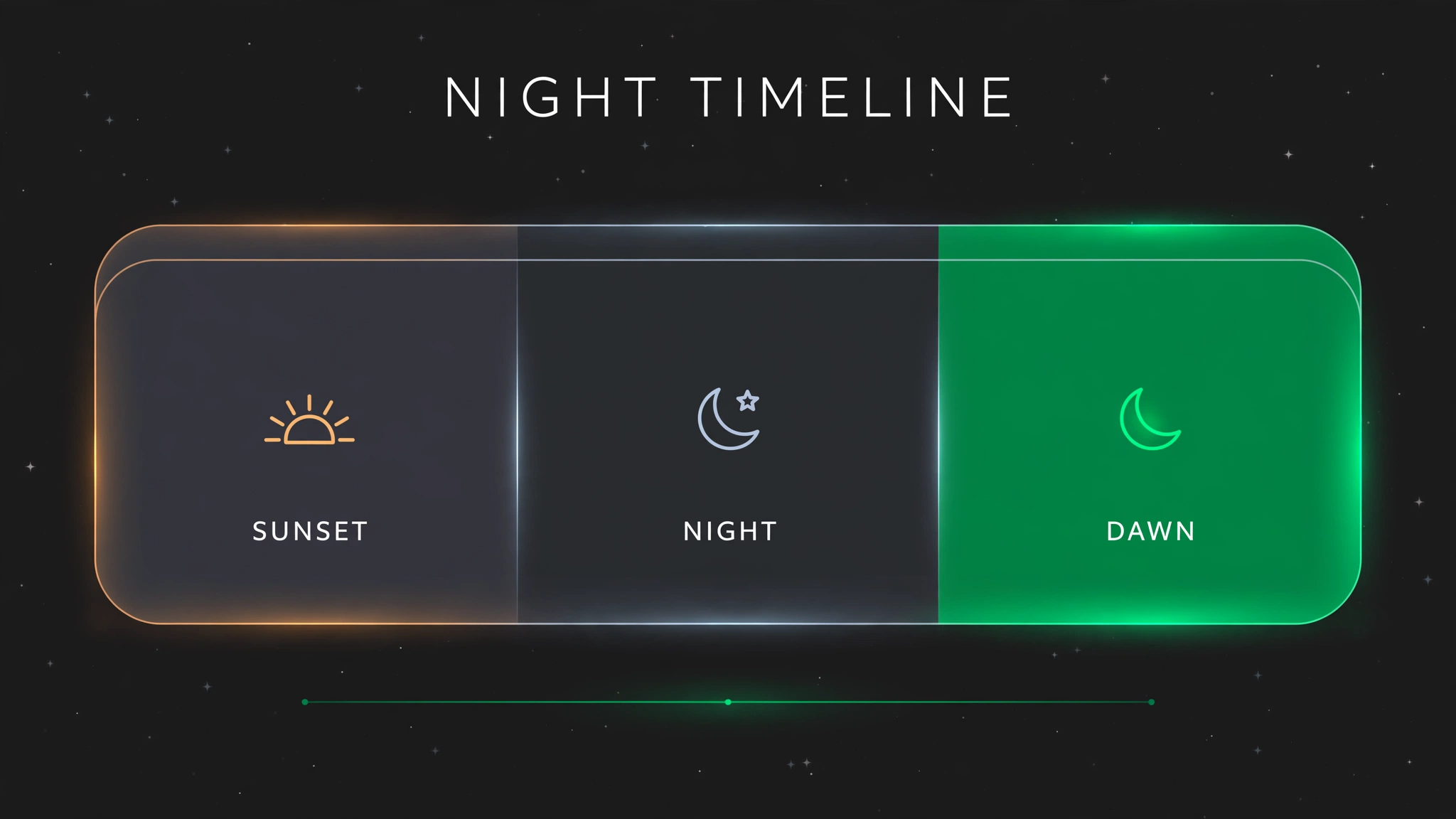
The Islamic night runs from Maghrib (sunset) to Fajr (dawn). Divide it into three equal parts — Tahajjud is prayed in the final part.
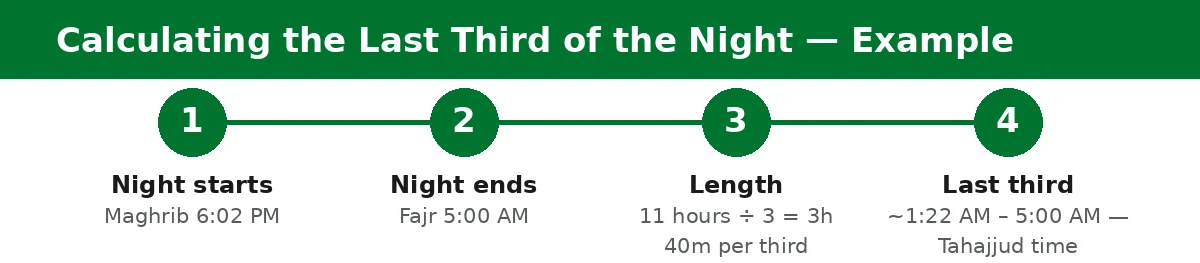
Worked example — night of Oct 8–9, 2026:
| Step | Calculation |
|---|---|
| Night starts (Maghrib) | 6:02 PM |
| Night ends (Fajr) | 5:00 AM |
| Total night length | 11 hours |
| One third | 3 hours 40 minutes |
| First third | 6:02 PM – 9:42 PM |
| Second third | 9:42 PM – 1:22 AM |
| Last third (Tahajjud time) | ~1:22 AM – 5:00 AM |
The formula works for any night of the year: (Fajr time − Maghrib time) ÷ 3, then count back from Fajr. In summer the night is shorter (Maghrib ~7:12 PM, Fajr ~4:00 AM), so the last third starts later relative to midnight; in winter it starts earlier.
How Many Rakats Is Tahajjud?
- Minimum: 2 rakats
- Common Sunnah practice: 8 rakats, prayed in pairs of two
- Close with Witr (1 or 3 rakats) — Witr should be the last prayer of your night
If you prayed Witr after Isha and then wake for Tahajjud, simply pray Tahajjud without repeating Witr.
How to Pray Tahajjud (Step by Step)
- Sleep first — Tahajjud is specifically the prayer after waking from sleep (this is what distinguishes it from praying late before bed)
- Wake in the last third of the night and make wudu
- Pray 2 rakats at a time — recite longer portions of Quran if you can, and lengthen your sujud
- Make dua — the last third of the night is described as a time when dua is especially accepted
- Close with Witr if you haven’t prayed it yet
Visual walkthrough: How to Perform the Tahajjud Prayer (The Night Prayer) — YouTube.
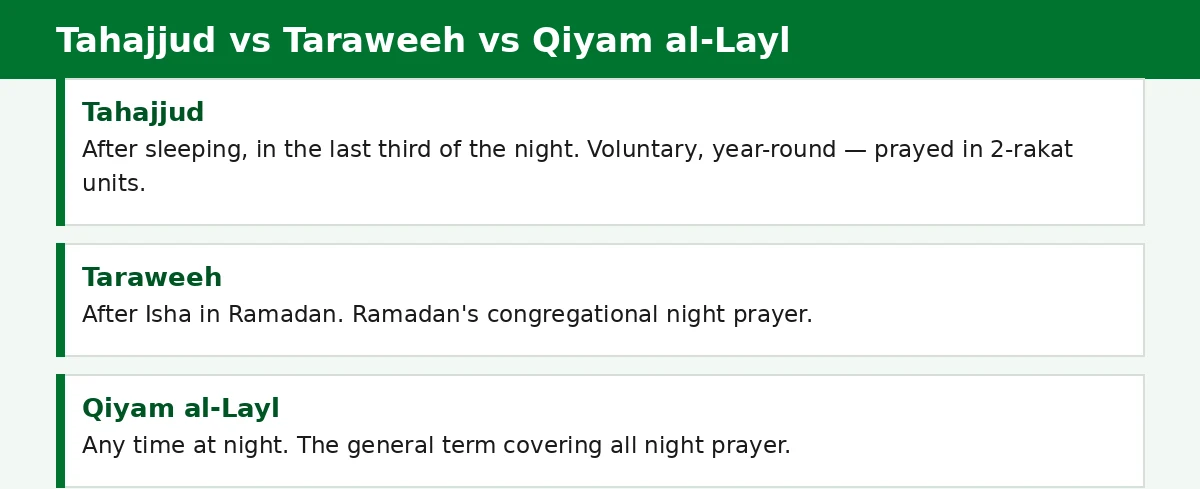
Tahajjud vs Taraweeh vs Qiyam al-Layl
| Prayer | When | Notes |
|---|---|---|
| Tahajjud | After sleeping, last third of night | Voluntary, year-round |
| Taraweeh | After Isha in Ramadan | Ramadan’s congregational night prayer — see our Taraweeh guide |
| Qiyam al-Layl | Any time at night | The general term covering all night prayer |
Tips for Waking Up for Tahajjud
- Sleep early — the single biggest factor
- Set an alarm for the last third (calculate it with the formula above)
- Make the intention before sleeping and ask Allah for help waking
- Keep water and your prayer mat ready to minimize friction
- Start small — even 2 rakats consistently is better than an ambitious plan you abandon
For the complete daily schedule, see our Abu Dhabi prayer time guide and the monthly prayer timetable.
The Hadith of the Last Third: “Who Will Call Upon Me?”
Tahajjud’s status rests on one of the most widely transmitted hadiths in the religion. Abu Hurairah narrated that the Prophet (peace be upon him) said: “Our Lord descends every night to the lowest heaven when the last third of the night remains, and says: ‘Who will call upon Me, that I may answer him? Who will ask of Me, that I may give him? Who will seek My forgiveness, that I may forgive him?'” (Bukhari, Muslim).
The narration comes through some twenty-eight Companions — an exceptionally broad transmission. This is the “why” of Tahajjud: the last third of the night is not merely quiet and undisturbed. It is, by explicit divine announcement, the hours when calling, asking, and seeking forgiveness are answered.
How the Prophet Prayed the Night Prayer
Aisha (may Allah be pleased with her) described his night prayer: “He never exceeded eleven rakats in Ramadan or at any other time. He would pray four — do not ask about their beauty and length — then four, then three” (Bukhari). The pattern within that:
- Two by two — the night prayer is prayed in pairs, then closed with Witr as a single rakat
- Length over quantity — “do not ask about their beauty and length”: long recitation, unhurried bowing, extended prostration
- One Witr per night — “There cannot be two Witr prayers in one night” (Ahmad), so Tahajjud after an earlier Witr is prayed without repeating it
You don’t need to match eleven rakats to begin. Two sincere rakats, prayed regularly in the last third, outweigh an ambitious plan abandoned after a week.
What to Recite and Ask For
The descent hadith itself hands you the night’s agenda — three requests: call upon Him, ask of Him, seek His forgiveness. Build your dua around those three: praise and calling, your needs and wants, and istighfar.
For recitation, follow the Prophetic pattern of “beauty and length”: longer portions of Quran than your daytime prayers, recited slowly and reflectively. Tahajjud is the opposite of a rushed prayer — its whole point is unhurried presence in the quietest hours.
Common Mistakes in Tahajjud
- Praying late without having slept and calling it Tahajjud. That is Qiyam al-Layl — still rewarded — but Tahajjud specifically follows sleep. Sleep first, even briefly.
- Repeating Witr after already praying it after Isha. One Witr per night.
- Waking for Tahajjud but sleeping through Fajr. The night prayer never justifies missing the dawn one. The fix is upstream: sleep early after Isha.
- All-or-nothing thinking. Missing one night doesn’t cancel the habit; the Sunnah is consistency, not perfection.
Frequently Asked Questions
What time is Tahajjud in Abu Dhabi?
Tahajjud is prayed in the last third of the night — roughly 1:20 AM to Fajr (5:00 AM) on the night of Oct 8–9, 2026. Calculate it for any night: (Fajr − Maghrib) ÷ 3, counted back from Fajr.
How many rakats is Tahajjud?
At least 2; the common Sunnah practice is 8 rakats in pairs of two, closed with Witr.
Do I have to sleep before praying Tahajjud?
Yes — that is what makes it Tahajjud rather than general night prayer (Qiyam al-Layl). Sleep, wake in the last third of the night, then pray.
When does Tahajjud time end?
At Fajr. The window closes when the dawn prayer begins.
What is the difference between Tahajjud and Taraweeh?
Tahajjud is the year-round voluntary night prayer after sleeping; Taraweeh is Ramadan’s congregational night prayer after Isha.
Should I pray Witr before or after Tahajjud?
After — Witr should be the last prayer of the night. If you already prayed Witr after Isha, pray Tahajjud without repeating it.
Can women pray Tahajjud?
Yes — Tahajjud is recommended for everyone, prayed at home.
What dua should I make in Tahajjud?
Any sincere dua — the last third of the night is described as a time when supplication is especially accepted. Pray for yourself, your family, and the Ummah.
What did the Prophet say about the last third of the night?
“Our Lord descends every night to the lowest heaven when the last third of the night remains, and says: ‘Who will call upon Me, that I may answer him? Who will ask of Me, that I may give him? Who will seek My forgiveness, that I may forgive him?'” (Bukhari, Muslim).
How exactly did the Prophet pray Tahajjud?
Never more than eleven rakats — prayed two by two with long, beautiful recitation — then closed with Witr as a single rakat (Bukhari). One Witr per night: never repeat it.
What should I recite and ask for in Tahajjud?
Longer Quran recitation than daytime prayers, recited slowly. For dua, use the hadith’s own three requests: call upon Him, ask of Him, and seek His forgiveness.
I can’t wake up at night — can I pray before sleeping?
That is Qiyam al-Layl (general night prayer) — rewarded, and better than nothing. But Tahajjud proper is prayed after sleeping, in the last third of the night. Try sleeping earlier after Isha first.
Last updated: October 2026. Prayer times shift daily — always confirm with your local mosque.
Pingback: Taraweeh Prayer Time Abu Dhabi: Ramadan Guide (2026)